44 labels in assembly language examples
PDF Assembly Language Programming - UTEP - Labels are symbols - Labels must begin in column 1. - A label can optionally be followed by a colon - The value of a label is the current value of the Location Counter (address within program) - A label on a line by itself is a valid statement - Labels used locally within a file must be unique. Adapted from notes from BYU ECE124 5 PDF Assembly Language: Overview - Princeton University Jump and Labels: While Loop! while (n>1) { } Checking if EDX is less than or equal to 1. 28 movl %edx, %eax andl $1, %eax je else jmp endif else: endif: ... • Read more assembly-language examples! • Chapter 3 of Bryant and OʼHallaron book! • Generate your own assembly-language code! • gcc217 -S -O2 code.c!
Assembly Language | 101 Computing Assembly languages also let you use labels in the code to point to specific memory locations or registers. LMC LMC (Little Man Computer) is an example of basic assembly language used for educational purposes. It consists of only 11 mnemonics (e.g. INP, OUT, STA, BRP, etc.) and is based on one memory addressing mode: direct addressing. ...

Labels in assembly language examples
2 Assembly Language Programming - University of New Mexico In an assembly language program, a label is simply a name for an address. For example, given the declarations shown in Example 2.1, ``x'' is a name for the address of a memory location that was initialized to 23. On the SPARC an address is a 32-bit value. As such, labels are 32-bit values when they are used in assembly language programs. PDF Assembly Language - University of Texas at Austin NOW, Under21, R2D2, and C3PO are all examples of possible LC-3bassembly language labels. There are two reasons for explicitly referring to a memory location. 1. The location contains the target of a branch instruction (for example, AGAIN in line 0E). 2. What Is Assembly Language (With an Example) | Indeed.com In this example, "1:" is the label, which lets the computer know where to begin the operation. The "MOV" and "ADD" is the mnemonic command to move the number 3 into a part of the computer processor where it can function as a variable. "EAX," "EBX" and "ECX" are the variables. The first line of code loads 3 into the register "eax."
Labels in assembly language examples. Assembly language - Wikipedia Example: in the following code snippet, a one-pass assembler would be able to determine the address of the backward reference BKWD when assembling statement S2, but would not be able to determine the address of the forward reference FWD when assembling the branch statement S1; indeed, FWD may be undefined. Embedded Systems - Assembly Language - Tutorials Point The names used for labels in assembly language programming consist of alphabetic letters in both uppercase and lowercase, number 0 through 9, and special characters such as question mark (?), period (.), at the rate @, underscore (_), and dollar ($). The first character should be in alphabetical character; it cannot be a number. Label (computer science) - Wikipedia In assembly language labels can be used anywhere an address can (for example, as the operand of a JMP or MOV instruction). Also in Pascal and its derived variations. Some languages, such as Fortran and BASIC, support numeric labels. Labels are also used to identify an entry point into a compiled sequence of statements (e.g., during debugging ). 8051 - "Label" in Assembly language - Stack Overflow Sep 12, 2014 · "Label" in Assembly language Ask Question 1 I have couple of examples which are pretty simple except LABEL concept. Example 1 adds 25 10 times in itself, whereas example 2 takes complement of Register A 700 times.
Labels (x86 Assembly Language Reference Manual) - Oracle When a numeric label is used as a reference (as an instruction operand, for example), the suffixes b ("backward") or f ("forward") should be added to the numeric label. For numeric label N, the reference Nb refers to the nearest label N defined before the reference, and the reference Nf refers to the nearest label N defined after the reference. pic microcontroller assembly language programming examples For example MOVLW is an Opcode. Labels. A label is an identifier used to represent a line in code or section of a program. Goto statements can be used in conjunction with a Label to jump to the execution of code identified by the particular label. See Task 1 code for example. ... pic microcontroller assembly language examples 6. Labels and Mainframe Assembler Macro Usage Macro with Branch & Labels The following examples will show how to use Macro Files that will generate code with Branch Instructions and unique labels. Branch with a Specified Label Using explicit names in the mainline code creates code that is simple and easy to understand. Example of Assembly - University of Aberdeen Example of Assembly. Source code format. A typical line in assembly language programme might be as follows: LOOP: MOV.B r0, #80 ;initialise counter. This line will be assembled into a single instruction (in this case 11 0000 1000 0000 in binary, or 3080); the assembly language and the machine code correspond to each other.
LC3 Assembly Language.ipynb - Bryn Mawr College The assembler first goes through the source code collecting labels, and their locations. During the second pass, it can substitute the used label in the operands with the label location minus instruction location - 1. .ORIG x4000 x4000 LD R1, SIX x4001 HALT x4002 SIX: .FILL #23 .END. So, the PC-offset for SIX is x4002 - x4000 - 1 = 1. Example of label in assembly language - Australia ... Apr 25, 2022 · Chapter 3 Assembly Language Fundamentals Data label • must be unique • example: count (not followed by colon) count DWORD 100 Code label 5 A Simple Assembly Language The simple assembly language Figure 5. 2 Example of Labels in Blocks One directive remains, It Is the ‘label setting directive’ . Assembly Language Syntax by Valvano Examples. Assembly Language Syntax Programs written in assembly language consist of a sequence of source statements. Each source statement consists of a sequence of ASCII characters ending with a carriage return. Each source statement may include up to four fields: a label, an operation (instruction mnemonic or assembler directive), an operand ... What are Labels in assembly language? - Quora The label is in fact a shorthand for skipping the manual calculation of the number of bytes to add to or subtract from the index pointer, for jump to label means just setting the new place in the memory the execution should continue at, ip+ or - some value.
(PDF) Elementary teachers’ use of language to label and interpret science concepts
Learning Assembly Language | Codementor Labels. In assembly language, we use lots of labels. The usages of the labels translates into numbers in machine code and the labels disappear in the machine code. ... (really fast). For example, to the hardware, most registers are equivalent, even though the registers are partitioned or assigned particular uses by the software conventions ...

Room 5 @ Melville Intermediate School: Melville Intermediate - Maori Language Week Activities
PDF Lecture 5 Basic Elements of Assembly Language Data Labels : a data label identifies the location of a variable, providing a convenient way to reference the variable in code. The following, for example, defines a variable named count: count DWORD 100 The assembler assigns a numeric address to each label. It is possible to define multiple data items following a label.

Pyramid Puzzle - Assembly Triad Puzzle with Free Shipping – SiamMandalay
PDF Chapter 3 Assembly Language Fundamentals Assembly language instructions can have between zero and three operands, each of which can be a register, memory operand, constant expression, or I/O port. ... • constant expression: ex. 10 * 10 • register: ex. eax • memory (data label): ex. count Examples of assembly language instructions having varying numbers of operands • No ...

Assembly - Loops - Tutorials Point Assembly - Loops. The JMP instruction can be used for implementing loops. For example, the following code snippet can be used for executing the loop-body 10 times. The processor instruction set, however, includes a group of loop instructions for implementing iteration. The basic LOOP instruction has the following syntax −.
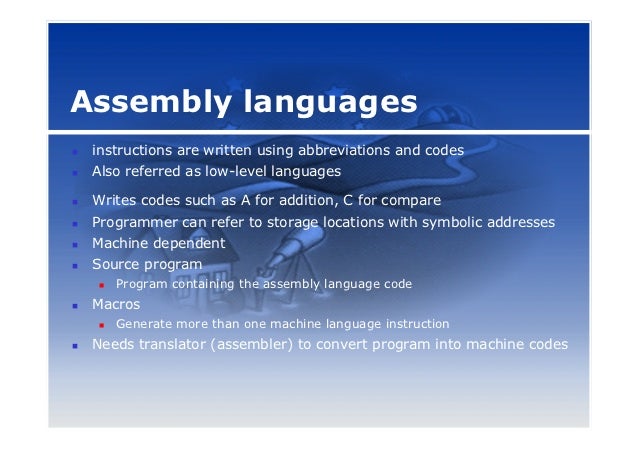
Programming language
Jumping to Labels in Inline Assembly | Microsoft Docs Assembly instructions can jump to a C or C++ label without regard to case. Don't use C library function names as labels in __asm blocks. For instance, you might be tempted to use exit as a label, as follows: Because exit is the name of a C library function, this code might cause a jump to the exit function instead of to the desired location.
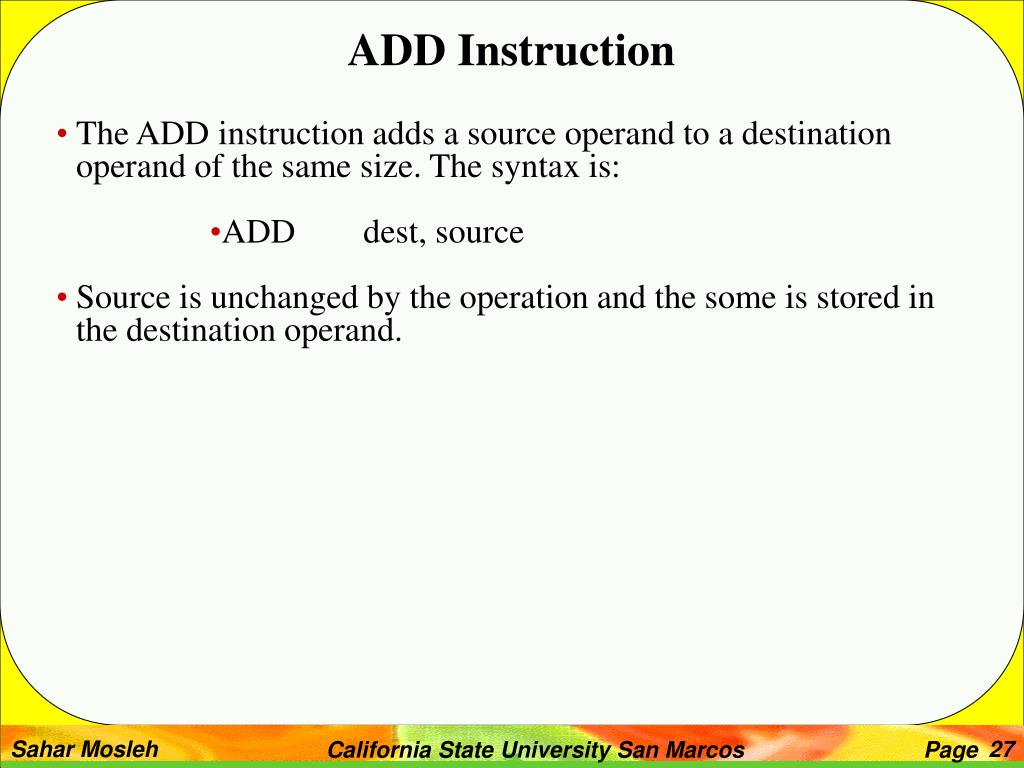
PPT - Introduction to Assembly language Data Definition Reserve words Labels Instruction ...
Local Labels - Elements of Assembly Language Here are some examples of legal identifiers: Grab Hold Widget Pot_of_Message MAXNAME A numeric label consists of a digit (0 to 9) followed by a colon. As in the case of alphanumeric labels, a numeric label assigns the current value of the location counter to the symbol.
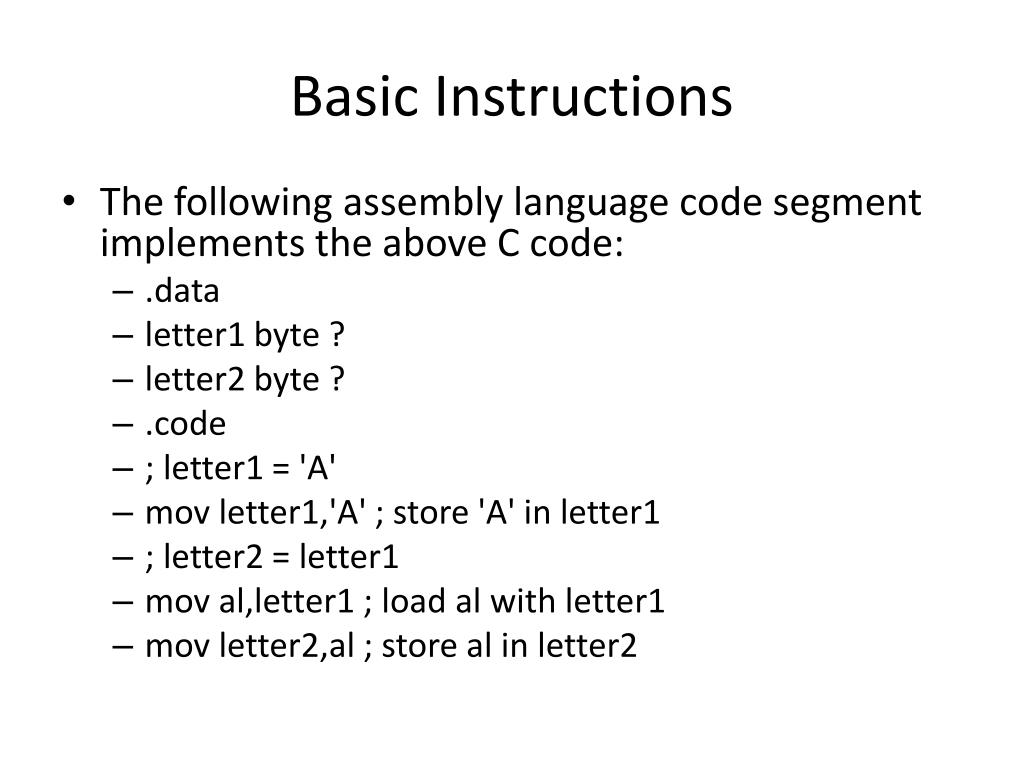
PPT - Elements of Assembly Language PowerPoint Presentation - ID:2280712
PDF George M. Georgiou Brian Strader - Georgetown University In the hello world example, line 7 contains the label "HW." The program uses this label to reference the "Hello World!" string. Labels are also used for branching, which are similar to labels and goto's in C++. Labels are optional and if an instruction does not have a label, usually empty space is left where one would be.

Assembly - Label | Assembly | Datacadamia - Data and Co Grammar - Label in Assembly. A label is a name given to an addresses. Without the programmer would be required to manually calculate them. It's used to identify a target address storing: a instruction for a branch instruction (ie the value of the target address is executed) data (ie the value of target address is used as data in an operation)
31 A Style Of Language Use In Which Language Is Used Primarily To Label Objects Is Called ...
SECTION V-10: Rules for Labels in Assembly Language The names used for labels in assembly language programming consist of alphabetic letters in both upper and lower case, the digits 0 through 9, and the special characters question mark (?), period (.), at (@), underline (_), and a dollar sign ($). The first character of the label must be an alphabetic character.
Post a Comment for "44 labels in assembly language examples"